September 15thWhat Makes a Mennonite? Learning with the Indonesian Church
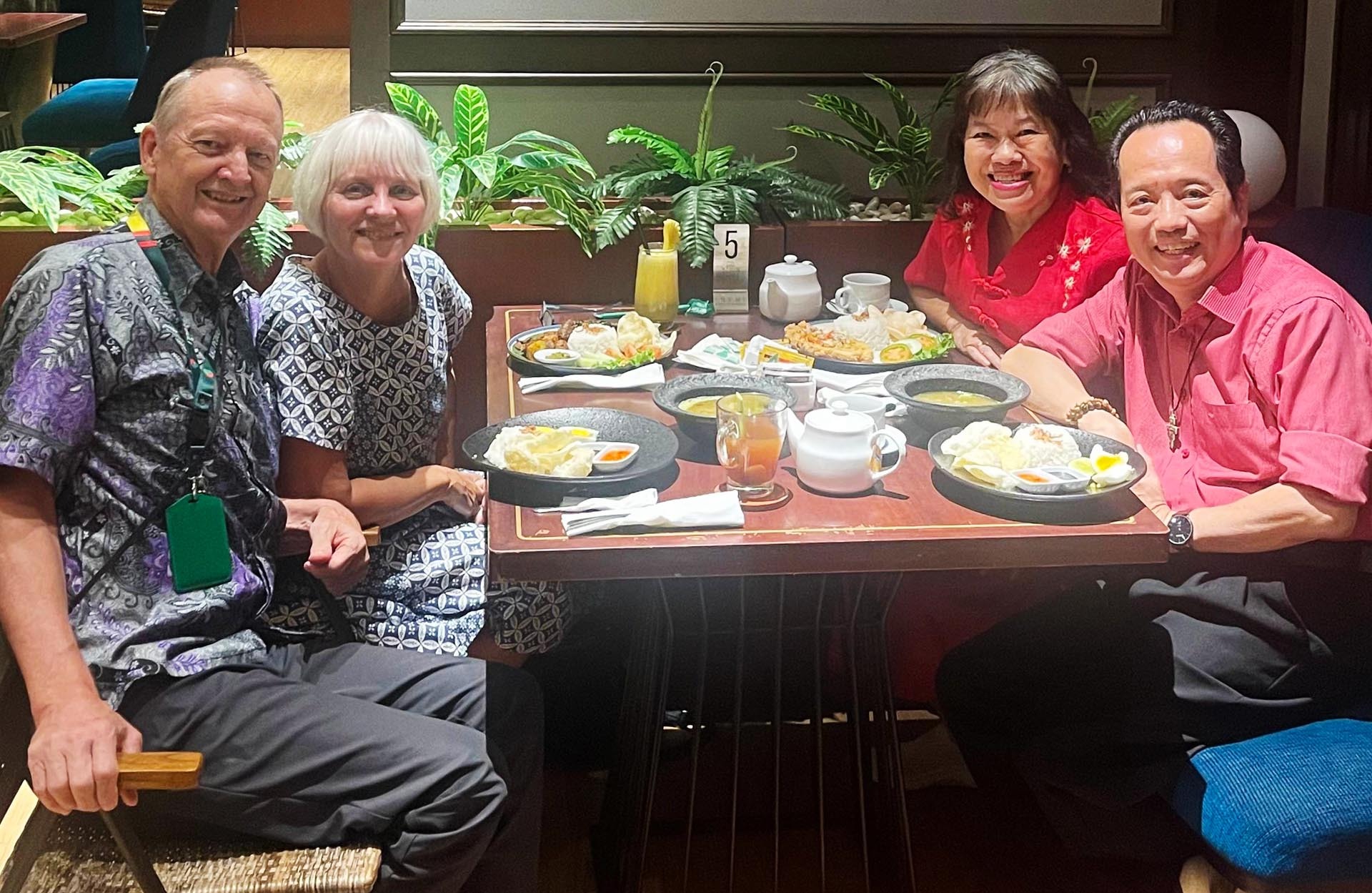
Wendy Kroeker and Gordon Zerbe (Fort Garry Mennonite Fellowship) returned to Indonesia this year as visiting professors invited by the Faculty of Theology at Duta Wacana Christian University in Yogyakarta—but this time found themselves engaging more intentionally with local Mennonite congregations and other gatherings of Mennonite leaders. (Photo above: Gord and Wendy with Paulus and Janti Widjaja)
“We were asked to lead special seminars, participate in sharing sessions, and preach on Sunday mornings,” says Gordon. “Our presence seemed to give our hosts and their congregations a special opportunity to explore for themselves, in conversation with us, what it means to be ‘Mennonite’ in their own contexts.”
The Indonesian context is significantly different than our Canadian context, notes Gordon. “Indonesia is so thoroughly religious—their form of democracy, for instance, is labelled ‘religious democracy,’ not ‘liberal democracy’—and the largest Muslim-majority country in the world.” This stands in stark contrast to our “increasingly non-religious context” with “culture wars [that] are of a completely different order,” he says.
Wendy describes one highlight of her time in Indonesia which illustrates these differences. “The city of Solo has a history of violence between faith groups, and the Mennonite church there has been working for years in partnership with city officials to enhance inter-faith relationships,” Wendy says. “Our participation was in a workshop focusing on training young adults for community peace work. In the midst of spaces that could nurture violence, the Solo Mennonite church is growing peace by investment in their young adults.”
Gordon remarks on his collaboration with Mennonite professor Paulus Widjaja. “Over the years, Paulus has made numerous converts among his students from mainstream Protestant faith traditions toward embracing an Anabaptist faith commitment,” Gordon says. “Many of these are now in significant pastoral positions in [Mennonite World Conference-affiliated] churches, and we had a chance to meet a number of them. Those we met were especially keen to continue to explore what it means to be a church in an Anabaptist-Mennonite mode.”
So what does it mean to be Mennonite in Indonesia? In summing up their conversations with Indonesian Mennonites, Gordon says it is largely the continued discernment about the meaning of Scripture, seeking interaction and relationships with those in more established Mennonite traditions—with a keen desire to live out a thoughtful peace theology in practical ways. “It’s not the memory of being part of an established ethno-religious tradition.”
As a regional church of Mennonite Church Canada, which is in turn a member church of Mennonite World Conference, Mennonite Church Manitoba has important connections with companions in faith and ministry around the world. To learn more, or to give financially to support these relationships, see www.mennonitechurch.ca/international-witness.